Economics for Business, 2nd Ed.
Blending Theory & Practice
By Ian Worthington, et al.
Financial Times / Pearson Education Limited
March 2005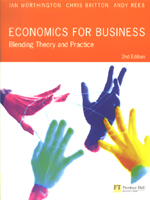
ISBN: 0273685600
558 Pages, Illustrated, 7 ½" x 9 ¾"
$82.50 Paper Original
This is a concise, business focused book which illustrates how the ideas and perspectives of economics can help us make sense of the world in which we live. This book takes a business first approach and then applies the economic theory to the business world. Business models such as Porter's five-forces are used to explain the relevance of the theory to business life and the real problems faced by firms and managers.
This highly accessible book takes a reader-centered approach, communicating complex ideas in a straightforward and easy to understand manner. The book is suitable for undergraduate students studying a one-semester business economics course as part of a business degree. The book will also be appropriate for DMS students and MBA modules in economics.
Features
" Case studies at the end of each chapter and mini cases within the chapter highlight key issues raised in the chapter and reinforce students' understanding of these issues.
" Excellent balance between discussion of economic theory and practical illustrations help students apply the theory they learn to the real world.
" Extensive pedagogy helps students gain a fuller understanding of key theories and concepts.
Includes: chapter objectives; questions and assignments, margin definitions etc.
" The main focus is on micro-economics, but macro analysis is introduced to help students gain a fuller understanding of the business world. Allows students to focus on the micro economic issues which affect business but provides them with an understanding of how business operates in the macro-eocnomy.
" Takes a global approach and includes chapters on international markets and environmental issues.
Contents
PART ONE: THE FIRM IN ITS ENVIRONMENT
1. Studying business economics
2. Organisation for production: practical and theoretical
PART TWO: DEMAND AND SUPPLY
3. Consumer and market demand
4. Consumer behaviour
5. Supply, costs and profits
6. Firms' objectives and behaviour
PART THREE: MARKETS AND PRICES
7. Market structures
8. Conduct and performance
9. Pricing in theory and practice
10. International markets
PART FOUR: GOVERNMENT, FIRMS AND MARKETS
11. Government and business 1
2. The macroeconomic environment of the firm
13. Human resource issues
14. Business, government and the natural environment
PART FIVE: ANALYSIS FOR BUSINESS DECISION MAKING
15. Linking business economics and business decision making
16. Estimating and forecasting techniques
INDEX
Return to the Businesss Titles Home Page